
SolarVenti Solar Air Heating Guide
SolarVenti solar air heaters and dehumidifiers — how they work, applications, FAQ.
Product Specifications
| Model | Type | Airflow | Noise | Coverage | Warranty | |
|---|---|---|---|---|---|---|
| SV3 Air | Solar air collector, smallest model, wall mount | — | — | 25 m² | 5 year factory warranty | Source |
| SV7 Air | Solar air collector, wall or roof mount, horizontal or vertical | — | — | 50 m² | 5 year factory warranty | Source |
| SV14 Air | Solar air collector, wall or roof mount, horizontal or vertical | approx. 60 - 110 m3 air per hour m³/h | — | 80 m² | 5 year factory warranty | Source |
| SV20 Air | Solar air collector, horizontal on roof or wall, or vertical on wall | ca. 80-140 m3 in blown air per hour m³/h | — | 100 m² | 5 year factory warranty | Source |
| SV30 Air | Solar air collector, largest standard model, horizontal on roof or wall, or vertical on wall | ca. 150 m3 in blown air per hour m³/h | — | 150 m² | 5 year factory warranty | Source |
| SVPro | Solar air collector for large scale commercial projects | — | — | — | 5 year factory warranty | Source |
Shop SolarVenti Products
 Sale
Sale
Frequently Asked Questions
How does the SolarVenti work from a technical point of view?
The system is free to run and is not connected to the main electricity supply. It is supplied with electricity via a solar cell. When the sun shines it warms up the air in the absorber and the integrated solar cell produces electricity for the built-in fan which blows the heated air into the house. Fresh air from outside is sucked / pulled in through a perforated back plate and a 2 mm black layer of felt. The air velocity is so low that only extremely small amounts of dust, pollen etc. are drawn into the system. This dust will eventually dissipate through use. When the system is running, air flow remains inside the panel. When the system is switched off, it cools itself down - even if there is bright sunshine. The heat rises inside the solar panel and exits via the felt and the back plate (open construction).
Why is there visible condensation on the inside of the top Lexan plastic layer of my SolarVenti solar air collector?
Once the SolarVenti has been installed, there will be visible condensation on the Lexan plastic finishing coat on the inside of the solar air collector at regular intervals. This is quite normal and will in no way damage the system. When the warm air in the solar panel meets the cold air - or at any rate colder air - outside the panel, the condensation will become visible. Therefore, condensation will be most common when the solar air collector starts up after an idle period due to cloudy weather. You can avoid the visible condensation by switching off the solar air collector for an hour or two depending on the weather conditions.
Is maintenance of a SolarVenti system necessary?
No, it is maintenance-free. Rain and snow wash dust, pollen and other impurities off the system.
Can dust get into the house or into the system?
No, the air is filtered through the felt. The felt cannot get clogged as the air is drawn into the absorber through the whole of the rear of the panel.
How does the system dehumidify? Other dehumidification systems have compressors. This one doesn't.
It is true that the SolarVenti itself does not dehumidify. The system has a dehumidifying effect due to the fact that it sends dry, warm air into the building at times when the air outside is at its driest and cleanest, i.e. when the weather is relatively clear. The best weather for dehumidification is actually a cold clear winter's day, even with a little snow on the ground. The air is particularly dry and clean and the reflection from the snow gives the system an extra boost.
What are the exterior SolarVenti panels made of?
The frame and the back plates are made of salt-resistant aluminum. This makes the SolarVenti easy to lift, move and install. Due to its construction, the solar air collector is immune to corrosion - even in an aggressive environment. The glass plate is not glass but UV-resistant Lexan (plastic) which has insulating properties and does not splinter if the SolarVenti is dropped during transport for example. The Lexan plate is shockproof and will not even break if you kick a football at it. It is also very easy to replace. All screws and rivets are made from stainless steel and salt-resistant aluminum.
What is the life expectancy for a SolarVenti?
Based on the experience of Danish customers with the early version of the holiday house pack, in which the solar cell was positioned next to the panel, we expect the life expectancy for the solar cell to be 10 - 20 years. This is the most critical component in the panel. The fan is one of the best and quietest on the market - a Sunon with double-row ball bearings and, in theory, 30,000 hours of operation which corresponds to approx. 25 years of wear and tear.
Why is the solar cell built into the panel?
It makes it easier to position the system on the wall or roof, and it looks nicer. The solar cell is more protected from hail, branches, footballs, wind and other types of weather when it is built into the panel.
How much noise does a SolarVenti make?
When it is running at full capacity, the acoustic pressure is approx. 40 db (plus/minus 2 db, depending on solar radiation). This corresponds to the noise from a very quiet extractor fan and we have not yet had any customers who have been bothered by the noise from the SolarVenti. Moreover, the noise level (air flow) can be adjusted using the fan's regulator. When the fan is turned down the temperature of the injection air should rise.
What is the difference between a regulator and an on/off switch?
The regulator can reduce the speed of the ventilator (air) and, thus, increase the heat of the air while reducing the noise level. The regulator can also be switched off if you turn it to zero. The on/off switch only has an ON/OFF function.
What is the optimal position for the system?
The system should face as close to due North as possible and have as little shade, from trees or other buildings, as possible.
Is it best to mount the system on a wall or a roof?
In theory, it is best to mount the system on a roof because the sun goes down at an angle on the west to the horizon. If you mount the panel on the roof, it must be tilted to 60 degrees in order to catch the winter sun. The pitch also ensures that dirt does not collect on the surface of the panel and snow does not lie on the light-permeable surface. Lastly, the pitch is required to ensure that the solar air collector panel can release heat when the system is switched off, e.g. on a warm summer day.
Does the panel have a right way up?
The solar air collector panel can be mounted vertically, like a door, or horizontally. The position is solely determined by what looks nicest and the limitations of the building itself.
Can the system keep the house frost-free?
At our latitude, temperatures must be extreme before the system is not able to keep the house frost-free. However, we cannot guarantee that the system will keep the house frost-free. There is also a great difference in the way in which houses are insulated and there are other crucial factors. For example, the way in which the air circulates differs from house to house. It is also of significant importance that the system has the right dimensions and is positioned correctly. The system must also have enough time/sun to ensure thorough dehumidification.
Can I change my mind about installation on a wall or roof?
Yes, we can always send our roof set on afterwards. All models are delivered with brackets for the wall.
How is the system delivered?
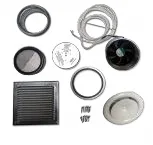
The system is delivered in the form of a do-it-yourself pack in a shock-proof cardboard box. All accessories, such as flexible pipes, vents, valve frames, straps, brackets and screws, are packed in a components box which is packed in the large cardboard box. Additional items - roof kit, insulated ducting etc, are separate items.
What happens when the system blows warm air into the house?
The system creates slight excess pressure in the house. This constantly pushes the old air out. The air will try to get out where the house is not tightly sealed, e.g. at doors, windows, ceilings and floors. You can send the air in the direction you want using the house's air escape vents. If you position the air escape vent(s) at the opposite end of the house to the injection air duct, the warm air from the solar air collector will be optimally distributed throughout the whole house.
How many meters of piping can be laid?
In general, shorter pipes give a better utilization of heat. If the piping must be longer than the lead-in through the wall, you should use smooth pipes in order to reduce resistance/pressure loss. Any/all ducting should be outstretched to provide smooth inner walls. Ducting should be double lined or insulated, preferably R1 or higher. External rigid stormwater with inner duct lining may also be used. In the case of the SV3, 1 to 2 meters of smooth insulated piping is the workable. In the case of the SV7 and SV14, 1 to 4 meters. In the case of the SV20, 1 to 5 meters. In the case of the SV30, 1 to 15 meters. Bends in ducting lines are acceptable, once they are not acute or sharp in which there would be efficiency loss. It is advisable to use an inline fan positioned closer to the exit point for long runs or for ducting down from a roof to a basement, as air is easier pulled than pushed.
How big is the SolarVenti box/packaging?
The dimensions of the SV3 box are: 96 x 60 x 14 cm. SV7 box: 119 x 77 x 15 cm. SV14 box: 217 x 77 x 15 cm. SV20 box: 217 x 104 x 15 cm. SV30 box: 306 x 106 x 9 cm. The box for the roof kit for SV7/14: 79 x 26 x 22 cm. The box for the roof kit for SV20: 108 x 26 x 22 cm. The box for the roof kit for SV30: 108 x 26 x 22 cm. The box for the SV30 PV panel: 110 x 69 x 15.
SolarVenti blows new air in. Where does the air come out again?
The air will automatically be drawn to the places where it is easiest to get out, e.g. to vents in kitchens and bathrooms or other vents and openings in the house. If possible, let the air blow directly into the most important room and open the doors to other rooms. You should be aware that a chimney damper in a chimney which is not in use will create an outlet for the air in the room.